Gyeondong Market
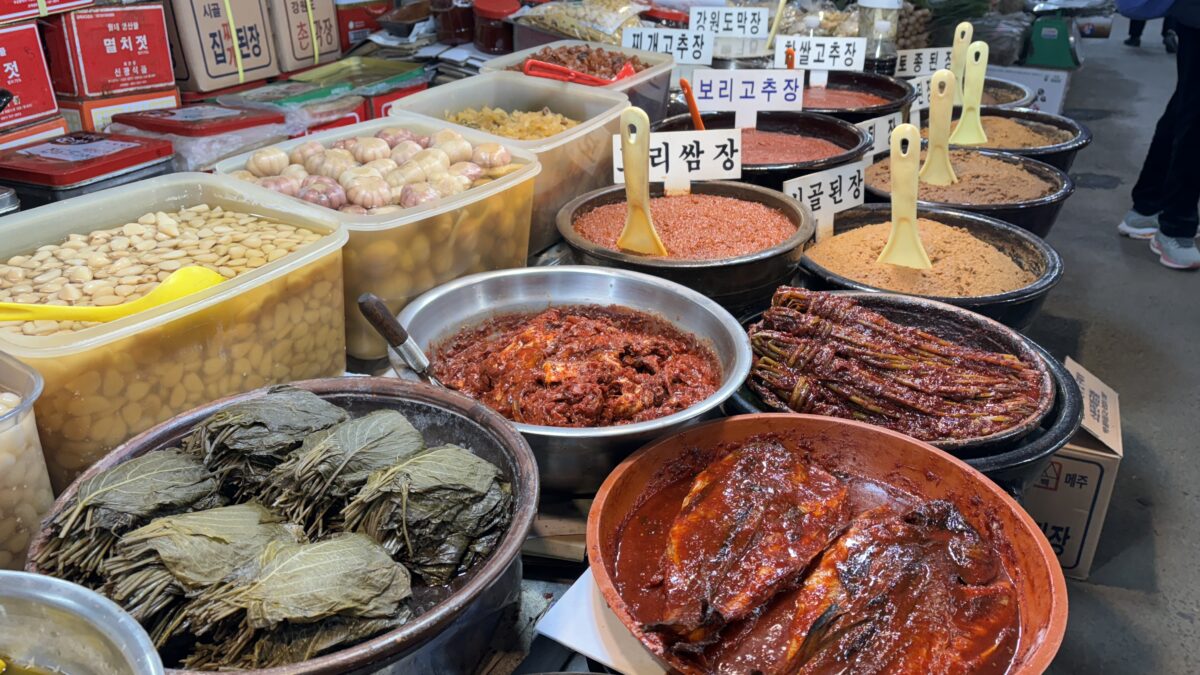
Gyeongdong Market is not an ordinary market. It is Korea’s largest hub for traditional medicine and dried goods, a place deeply connected to Seoul’s medical, commercial, and food history. More than a space of exchange, Gyeongdong is a territory of knowledge, practice, and transmission—where food and medicine naturally intersect.
Located in Jegi-dong, in Seoul’s Dongdaemun-gu district, Gyeongdong Market is officially known as Seoul Yakryeongsi. For decades, it has attracted herbalists, practitioners of traditional Korean medicine, chefs, and individuals from across the country.
A market born from traditional medicine
The foundations of Gyeongdong Market date back to the post-war period, but it was during the 1960s and 1970s that it truly established itself as the national center of traditional Korean medicine. As Seoul expanded, Jegi-dong naturally became the focal point for the distribution of medicinal herbs throughout the country.
Dried roots, barks, mushrooms, seeds, and rare medicinal plants—all elements of Korean pharmacopoeia—pass through Gyeongdong. The market did not grow around passing travelers, but around medical expertise and the trust placed in specialists.
Seoul Yakryeongsi: a unique ecosystem
Unlike most food markets, Gyeongdong operates as a professional ecosystem. Shops are often highly specialized: ginseng, medicinal roots, mushrooms, tonifying plants, or ingredients used specifically for herbal decoctions.
Vendors are not simply sellers. Many are experts capable of explaining the properties, uses, and combinations of each ingredient. Conversations frequently take place in medical terms, sometimes guided by traditional prescriptions.
Surrounding these shops are clinics of oriental medicine, preparation workshops, wholesalers, and institutions dedicated to research and the transmission of this knowledge.
Beyond herbs: a market of dried goods and long time
While Gyeongdong is best known for medicinal herbs, it is also a vast market for dried foods. Dried fish, seaweed, mushrooms, dehydrated fruits, grains, seeds, and condiments fill the narrow streets—ingredients used both in everyday cooking and in therapeutic preparations.
Here, time itself is an ingredient. Products are dried, aged, stored, and preserved. Gyeongdong represents a slower rhythm of Korean food culture—focused on prevention, balance, and care—rather than immediacy or convenience.
Resisting modernity without becoming a stage
Like many traditional markets, Gyeongdong has faced pressure from modern retail chains, standardization, and declining casual foot traffic. Yet it has never truly disappeared.
The reason is simple: its function remains essential. As long as traditional Korean medicine continues to be practiced, taught, and passed down, Gyeongdong remains indispensable. Modernization efforts have improved infrastructure without altering the market’s core structure.
Gyeongdong has not been turned into a tourist attraction. It continues to exist primarily for those who know why they come.
A market for those who know
Today, Gyeongdong is still frequented mainly by professionals, practitioners, elderly locals, and long-time customers. It is not immediately accessible to first-time visitors: smells are intense, products are often unlabeled, and interactions follow established codes.
Yet for those who take the time to observe and listen, Gyeongdong reveals a fundamental aspect of Korean culture—a holistic worldview in which food, medicine, and daily life are inseparable.
Why Gyeongdong Market matters
Gyeongdong Market is one of the rare places in Seoul where the city can still be read through its roots, both literally and symbolically. It tells the story of a society attentive to bodily balance, prevention, knowledge transmission, and the value of long-term thinking.
For us, Gyeongdong embodies the therapeutic and philosophical dimension of Korean food culture. It is not about trends or performance, but about a living system—still active, still relevant, and deeply embedded in everyday life.
Explore Gyeongdong with Korean Gourmet Hunters
If this approach to food and well-being resonates with you, we invite you to discover Gyeongdong Market through our Korean Wellness Tour.
Designed to explore the connections between food, traditional medicine, and everyday wellness, this tour offers ingredient literacy, cultural context, encounters with specialists, and a deeper understanding of Korean approaches to balance and care.
Joining our Korean Wellness Tour means going beyond a market visit.
It is an invitation to experience a different way of thinking about food, the body, and well-being—right in the heart of Seoul.